These examples make implementation decisions reviewable. The current catalog links to the published experiments and their companion lessons. Each lab identifies its synthetic fixtures, source package and implementation boundaries. Tests and benchmarks describe the local fixture, runtime and sample sizes shown with each result.
Loading the current implementation and recording review status.
The owner requires at least five substantive executor/independent-critic cycles for every update package. Accepted components, a prepared archive, a published site and a recorded video remain separate states. Recording scripts and actual screenshots are checked in each episode packet; no finished video is attached.
This next record belongs to the earlier PR2 candidate. Its historical tests and three-pass reviews do not certify the expanded portfolio or later recording additions. See the current status above.
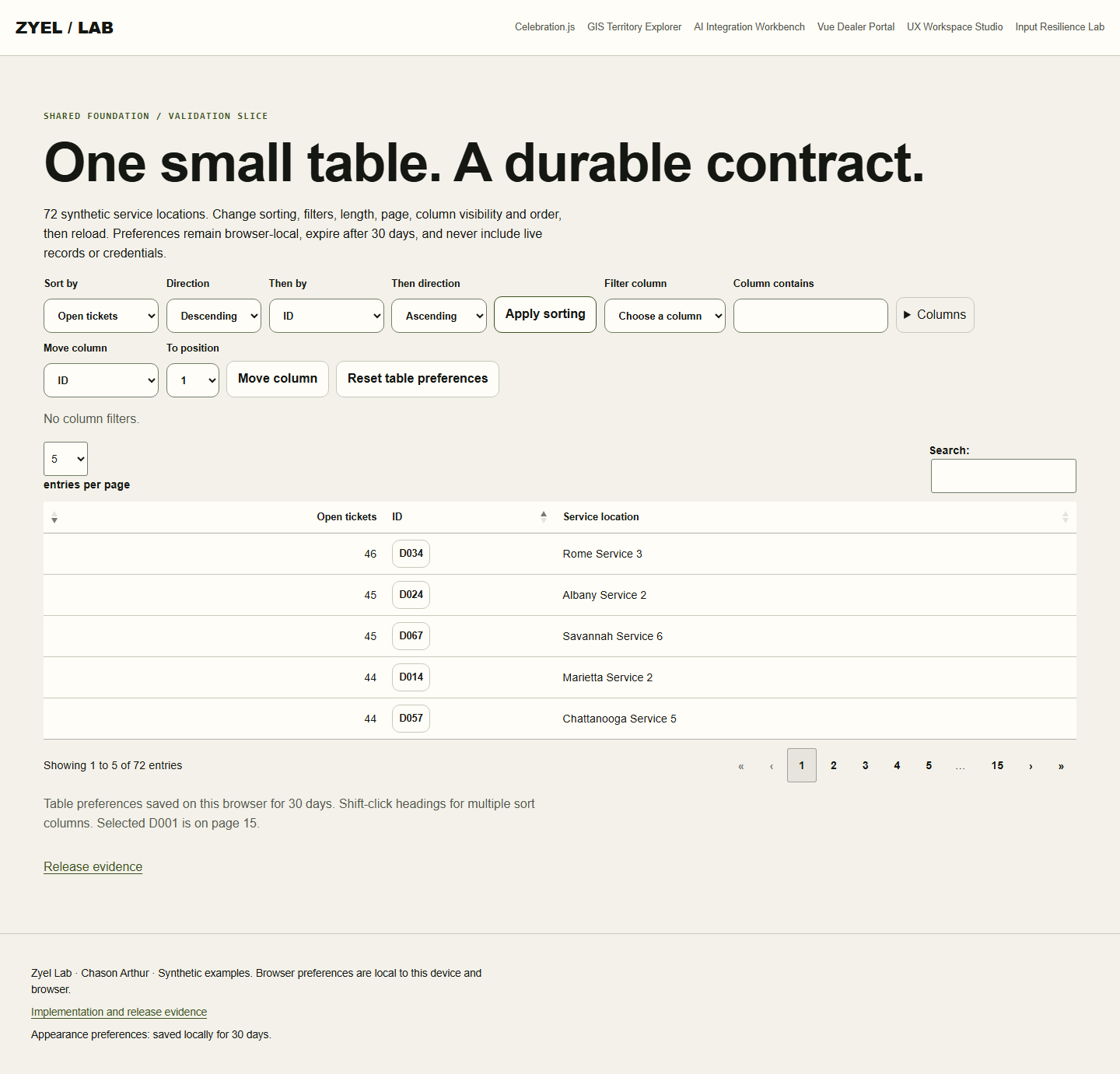
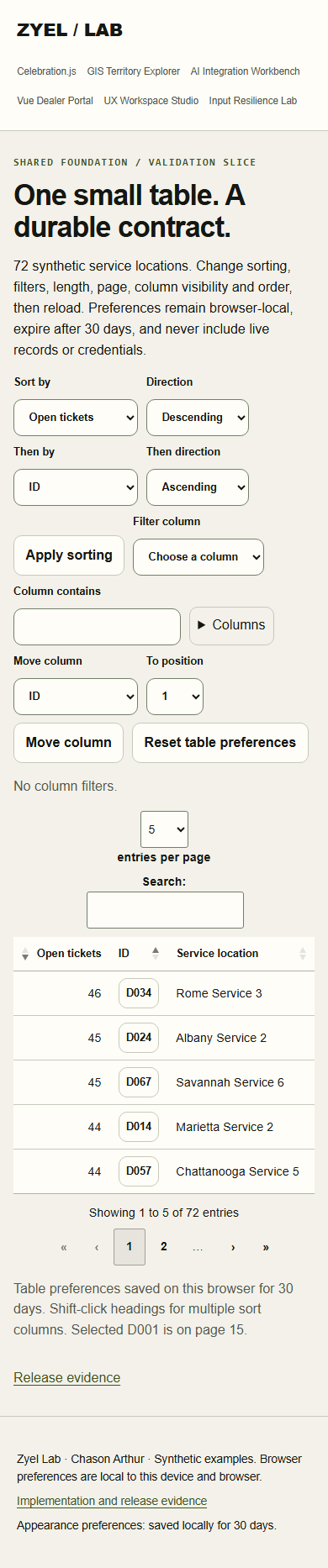
DataTables 3.1.4 and ColReorder 3.1.2 are pinned and self-hosted. The local Chromium test checks exact state readback after reload: ascending/descending multi-sort, search, page length/page, visibility and column order. It also tests a denied-storage fallback and a 390px layout. The storage unit suite covers invalid data, unsafe keys, quota failure, migration and expiration.
Chason Arthur is credited as Project Lead; observed source patterns and suggested improvements remain distinct, with no operating-country total.
Full-stack and data
The portal source contains a Laravel/PHP backend, policies, validation, transactional workflow, integration tests and a MySQL data model. SQLite and disposable MySQL CI executed the Laravel policy/transaction suite. The recorded MySQL query slice includes actual before/after plans and timings. Persistent identity and production operation remain separate. The public role preview is simulated.
AI and APIs
The workbench demonstrates structured contracts, exact fixture citations, review gates, adapters and evaluation cases. Deterministic output is labeled fixture mode. It does not establish a live provider's accuracy or operational cost.
GIS and hosting
The territory route is a mapping/analysis prototype with synthetic service locations. It illustrates a data publication and hosting architecture. One prototype does not fulfill the full three-dashboard ARC828 scope.
UX and WordPress
The Studio inventories its owned surfaces and applies allowlisted global appearance to the four published demos. The legacy Celebration playground and unsupported third-party internals retain their controls. Standalone Vue/CSS does not establish WordPress support experience; any unexecuted adapter stays a gap.
Input and telemetry
The input lab uses synthetic challenges and a simulated verifier. Bounded format validation complements authoritative server checks. A validation failure is an event, not proof of a malicious actor. AWS telemetry adapters require separately approved resources.
Use in proposals and applications
These demos can support technical discussions about PHP/Laravel/Vue/MySQL, API/AI integration, test strategy, CI, accessibility and query performance. They do not prove years of experience, academic qualifications, real people management, paying client references or high-traffic production operation.
ARC804v2 public scope addresses WordPress support/accessibility. ARC828 public scope addresses mapping dashboards and hosting. Confirm complete solicitation documents and their unlabeled time zones before asserting compliance. No bids or job applications are submitted by this release.
What publication requires
Review the draft source change and evidence, choose the static release scope, and separately authorize any backend or live provider configuration. Keep backend source, environment files, tools, tests and logs outside the public document root. Preserve a previous release for rollback and read back each authorized live route before calling it live.
Code walkthrough
Follow the implementation in code.
Use these examples alongside the steps on this page. Read the explanation before copying a snippet; source excerpts depend on the surrounding implementation, and illustrative examples are labeled.
Example 01 · Example
Read the published lab catalog
A read-only browser request lists the experiments included in the current catalog. Fetching a catalog does not run a demo or verify its claims.
const response = await fetch("/lab/catalog.json");
if (!response.ok) throw new Error("Catalog unavailable");
const catalog = await response.json();
console.log(catalog);
The manifest describes the source files belonging to one lab. Inspect it together with the matching setup instructions; a manifest is an inventory, not a substitute for testing.
const response = await fetch(
  "/lab/typescript-boundaries/source/manifest.json"
);
if (!response.ok) throw new Error("Manifest unavailable");
console.log(await response.json());
Run this locally after saving the named source archive. Compare the digest with the corresponding release record when one is supplied. Calculating a hash alone does not establish who produced a file.
from hashlib import sha256
from pathlib import Path

archive = Path("typescript-boundaries-source.zip")
print(sha256(archive.read_bytes()).hexdigest())
Example 05 · Local verification
Run a focused behavioral check
From the trusted matching source tree, run the TypeScript boundary tests. Keep the command’s result with the environment and source edition it actually tested.
# From the matching extracted source tree:
node --test tests/typescript.test.mjs
# For development type checks, follow GETTING_STARTED.md.